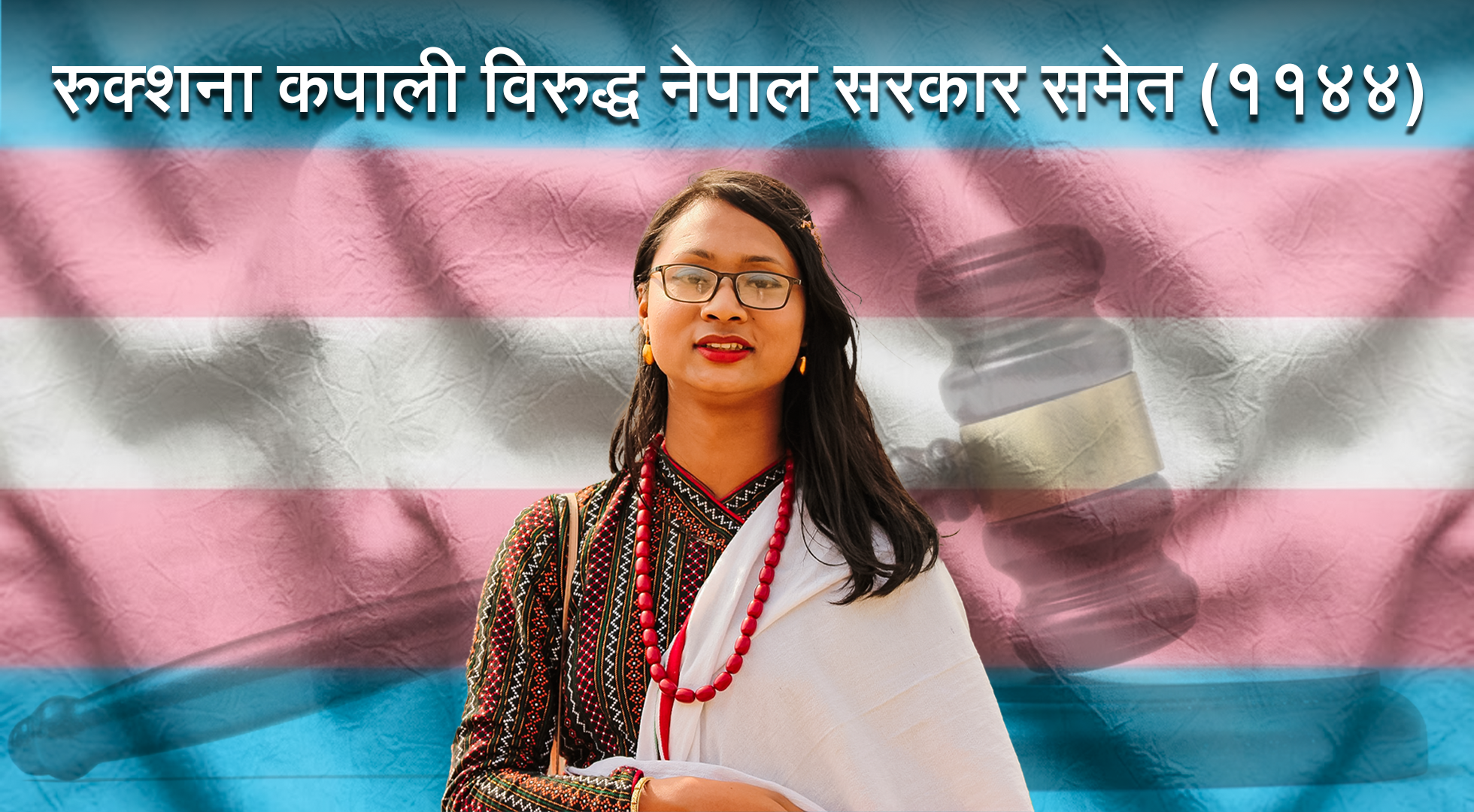
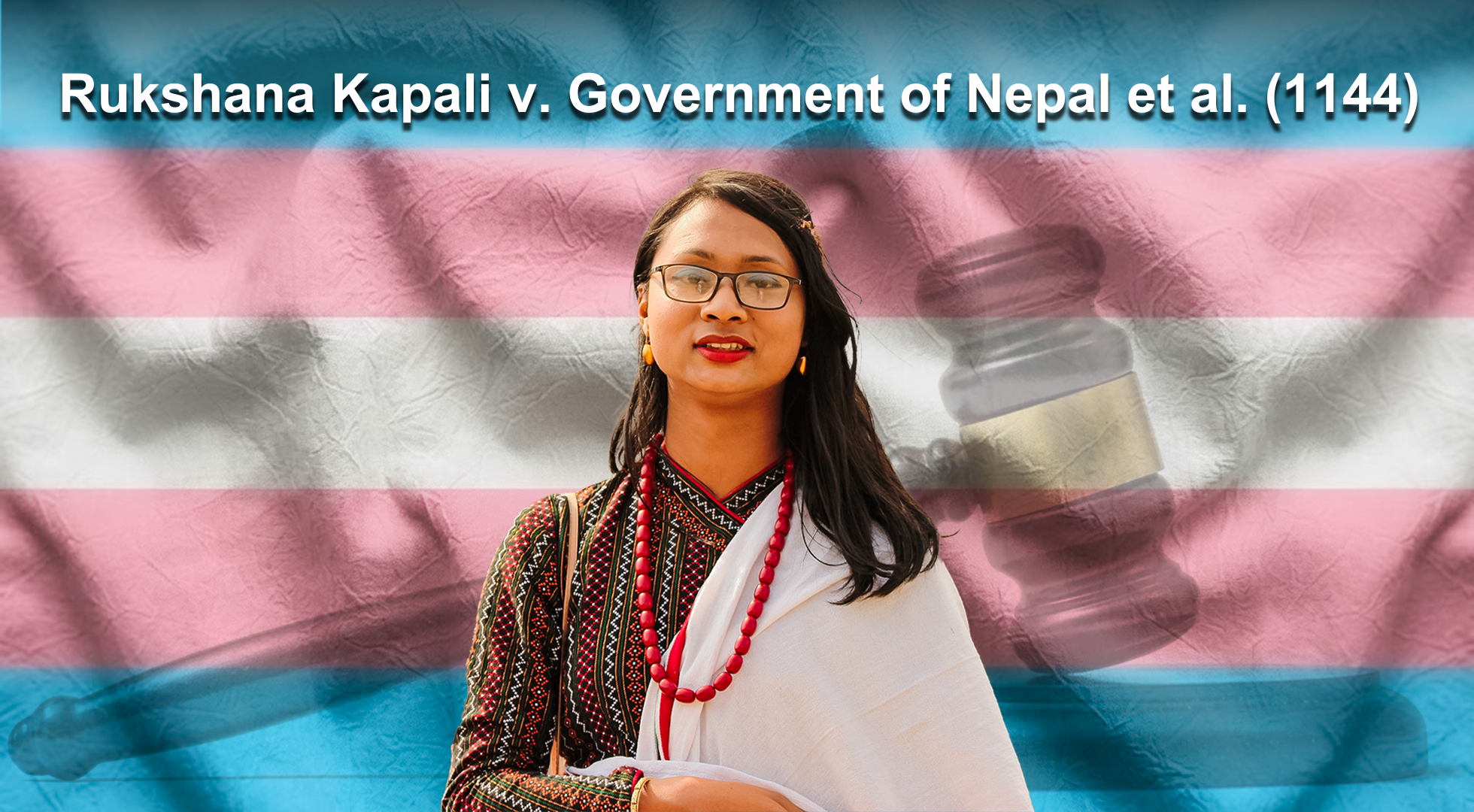
Rukshana Kapali V. Government of Nepal et. al. (1144)
This open-access repository provides certified court records, notarized translations, and community translations for the Supreme Court of Nepal’s landmark ruling in Rukshana Kapali v. Government of Nepal et al. (1144 i)

Summary
Kapali v. Nepal (1144) is a landmark Supreme Court judgment that pioneered legal gender recognition for transgender individuals in Nepal. This ruling marked the first Supreme Court judgment in Nepal to explicitly recognize the existence and legal status of binary transgender men and women. Previously, Nepal’s administrative framework recognized only a blanket “third gender,” denying trans men and trans women legal recognition in their gender identity.
Background of the Case
The case originated with Rukshana Kapali, who came out as a transgender girl during her early teens. While she was enrolled in secondary school, the administration refused to recognize her social transition or update her official records, leaving her no choice but to complete her secondary education documented as ‘male’. At age sixteen, she applied for a citizenship certificate, but authorities denied her request to be recognized as female. Instead, they imposed an ad-hoc compromise granting her preferred name while relegating her to an “Others” gender marker. She subsequently succeeded in registering under her gender as female for her higher secondary (+2) education. However, when she progressed to the undergraduate level, Tribhuvan University blocked her Bachelor’s registration due to discrepancies across her prior academic records. In response, she turned to what was then the only available legal mechanism; securing a formal ward-level recommendation designed to reconcile mismatched official records. Yet, even upon producing this legal document, the university still denied her registration. Concurrently, she pursued every available administrative avenue to correct the mismatch at its root. She submitted formal petitions to amend her secondary school records from “Male” to “Female,” while simultaneously pressing authorities to rectify her citizenship certificate by removing the “Others” marker. She was met with an unyielding bureaucratic deadlock: school boards would not alter her past academic certificates, and without those amended documents, Tribhuvan University would not accept her registration. Despite her persistent administrative efforts and appeals, relevant authorities refused to act, shielding their inaction behind procedural technicalities and the absence of specific legal provisions—effectively entrenching the discrepancies across her state records.
The systemic documentation crisis was not confined to university admissions, it rippled across every fundamental facet of her civil, professional, and civic existence. Because her foundational records were fractured across conflicting names and gender markers, routine civic procedures became insurmountable hurdles. State and commercial identity verification systems flagged her mismatched documentation, obstructing her ability to register essential personal assets, such as procuring a mobile SIM card under her own legal name, and compromising her financial autonomy. Internationally, her freedom of movement was compromised; she faced severe friction in obtaining and renewing travel documents, exposing her to heightened scrutiny and border harassment. Furthermore, the administrative impasse erected an impenetrable barrier to continuing education, precluding her from enrolling in alternative degree pathways, non-formal diplomas, or credit transfer programs, thereby imposing an ongoing, cross-cutting deprivation of her fundamental civil and economic liberties.
Nearly seven years after coming out, six years after receiving her citizenship certificate, and three years after she first attempted to register for her Bachelor’s degree, she was left with no choice but to take the matter to the Supreme Court in 1141. i
Ruling of the Court
In Kapali v. Nepal (1144), the Supreme Court of Nepal addressed and determined five key constitutional questions:
- Maintainability Under Extraordinary Jurisdiction: The Court held the petition admissible under Articles 46 and 133 of the Constitution, affirming that because ordinary statutory procedures (such as Section 17 of the Citizenship Act, 2063 and the Correction of Name, Age and Caste Rules, 2017) provide no remedy for legal gender recognition, extraordinary judicial intervention is essential.
- Right to Self-Perceived Gender Identity: Drawing on constitutional guarantees of dignity (Article 16) and equality (Article 18) alongside international human rights norms, the Court recognized gender identity as an inalienable right of self-determination grounded in individual self-perception rather than sex assigned at birth.
- Amendment of Civil Records to “Female”: The Court affirmed that transgender women are constitutionally entitled to amend their citizenship certificates, educational credentials, and public records to reflect their gender identity as “Female,” explicitly rejecting the state’s imposition of a blanket “Others” or “Third Gender” category.
- Confidentiality and Erasure of Deadname: Anchored in Article 28 (Right to Privacy) and the Privacy Act, 2075, the Court held that the state must maintain strict confidentiality over an individual’s birth name and former gender details, ruling that public disclosure of a deadname infringes upon personal dignity and invites systemic discrimination.
- Remedy and Judicial Relief: The Court issued a peremptory writ of mandamus directing all respondent government authorities and educational boards to amend and harmonize the petitioner’s official records in accordance with her gender identity.
Jurisprudential Significance & Impact
With its official publication in the Nepal Law Gazette, this ruling stands as an established legal precedent.
Nepal Law Gazette (NKP), 2082 B.S., Part 67, Issue 3, Decision No. 11406
Repository Overview & Document Index
This repository includes:
- Official Court Filings (Nepali): Complete, stamped photocopies of the officially filed documents, certified and verified by the Supreme Court of Nepal.
- Notarized English Translations: Certified English translations of key filings and judicial records, officially authenticated by a Notary Public.
- Community Translations: Community-led translations of the final ruling available in multiple local and indigenous languages of Nepal.
Access Note: Primary records and translated PDFs are permanently preserved and hosted on the Internet Archive (archive.org) to guarantee long-term open access. Clicking a document link will open the corresponding record directly in the Internet Archive repository.
Browse Records by Language
Select a language below to access the documents currently available in that language